

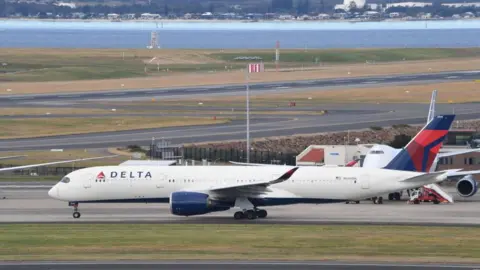
Multiple passengers and crew have been injured when a Delta jet from LA to Sydney, Australia was hit by turbulence this past Friday.
Delta Flight 41 "went through a short bout of rough air" as it landed at the Sydney airport, a representative for the carrier stated. A number of the onboard staff required medical attention.
Local paramedics said they treated five patients, and took three of them to hospital with minor injuries that comprised spinal discomfort and headaches. The injured were between their 30s to 70s.
This marks the newest example of planes encountering severe turbulence, with experts saying that shifting climate patterns is a significant contributor.
On board were nearly 250 travelers and 15 crew members on the aircraft, the official added, stating that the plane arrived "safely" at Sydney Airport at 06:48 local time on Friday morning.
The NSW Ambulance Service reported they were alerted just only 180 seconds ahead of the plane touched down, and ambulances were standing by on the runway.
The reasons turbulence is becoming more frequent - and often stronger.
In the previous year, two dozen individuals sustained injuries when a separate Delta aircraft, on a route from Salt Lake City to Amsterdam, Netherlands, encountered "significant" rough air just two hours into the long-haul flight, and had to make an emergency landing.
Recently, those on board on a Singapore Airlines flight experienced a terrifying short but intense of severe turbulence. An individual passed away and many were hurt, as those without seatbelts lifted out of their seats and crashed back down.
Turbulence is fairly routine while flying, and while occurrences of strong or severe turbulence are reportedly becoming more frequent, they are statistically infrequent.
Data suggests that there are approximately 5,000 incidents of severe-or-greater turbulence every year, out of a overall number of more than 35 million aircraft departures that now take off around the world.
Severe turbulence is described as when the vertical motions of a plane going through unstable air generate more than 1.5 times the force of gravity on your body - sufficient force to propel you from your seat if you weren't wearing a seatbelt.
As climate change modifies atmospheric conditions, specialists caution that air travel could become less smooth: warming trends and shifting wind patterns in the jet stream level are projected to increase the frequency and intensity of dangerous in-flight bumps.


